




What Key Parameters Should You Consider When Purchasing a Large Welded Pipe Production Line?
19 Nov,2026
Huaye
Learn the key parameters for choosing a Large Welded Pipe Production Line, including pipe specifications, welding quality, automation, auxiliary equipment, and manufacturer capabilities.
With the development of oil and gas transportation, urban infrastructure, and industrial pipeline projects, market demand for large-diameter welded steel pipes continues to grow. For companies planning to establish or upgrade a steel pipe manufacturing facility, choosing the right Large Welded Pipe Production Line affects not only production efficiency but also product quality, equipment stability, and long-term investment returns. Before purchasing equipment, manufacturers should evaluate several factors, including production specifications, processing capacity, automation levels, and auxiliary equipment.
1. Define Pipe Specifications and Diameter Range
Pipe specifications are among the first factors to consider when selecting a Large Welded Pipe Production Line. Different engineering projects require different pipe diameters, wall thicknesses, and lengths. Therefore, the production line must meet both current manufacturing requirements and potential future production needs.
For large-diameter spiral welded pipe manufacturers, it is important to check the minimum and maximum pipe diameters, steel plate thickness range, finished pipe length, and compatible steel materials. If a company plans to manufacture pipes in different sizes, such as 1020mm, 1420mm, or 2540mm, it should confirm whether the equipment supports these specifications and whether the corresponding production configurations are available. This helps prevent processing limitations from affecting future business expansion.
2. Evaluate Welding Processes and Processing Quality
Welding quality directly affects the structural strength and practical performance of finished steel pipes. During equipment selection, buyers should understand the welding processes, welding equipment configuration, and weld quality control capabilities of the production line.
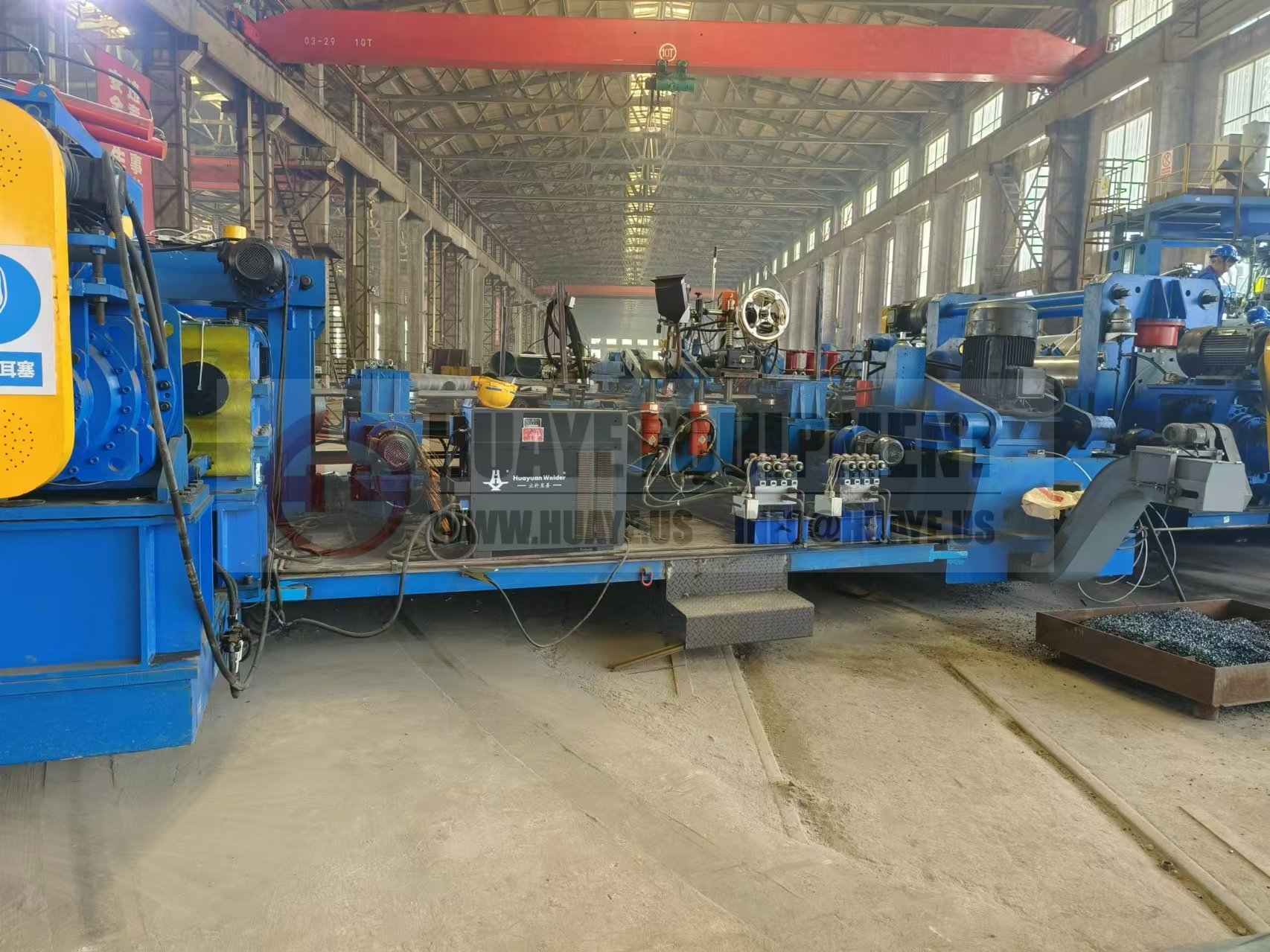
For a large spiral welded pipe production line, the forming process, welding operations, and equipment performance must work together efficiently. A stable forming system helps maintain pipe dimensions, while a properly configured welding system contributes to consistent production quality. Manufacturers should also check whether the production line includes weld inspection, pipe end processing, and other quality testing equipment to meet the requirements of different projects.
3. Assess Production Efficiency and Automation Levels
Production efficiency is an important factor affecting overall manufacturing capacity. When purchasing a Large Welded Pipe Production Line, buyers should not focus exclusively on the theoretical production speed. Actual performance should also be evaluated according to pipe specifications, material thickness, changeover time, and the overall production process.
A higher level of automation can reduce certain manual operations, improve coordination between equipment, and help minimize errors caused by manual handling. Buyers should pay attention to the main machine's operating speed, forming system control methods, welding automation configuration, and product changeover efficiency. These factors help determine whether the equipment can meet the company's requirements for large-scale production.

4. Check Auxiliary Equipment and Complete Line Configuration
A complete large welded pipe production line includes more than forming and welding machines. It also requires supporting equipment such as uncoiling machines, leveling machines, conveying systems, cutting machines, pipe end processing equipment, and inspection systems.
For example, a pipe end beveling machine processes pipe ends, a hydrostatic testing machine checks the pressure resistance of finished pipes, and a pipe end expander supports specific pipe processing requirements. During purchasing, manufacturers should evaluate the auxiliary equipment according to their product types and production processes. Proper coordination between machines helps prevent situations where the main production equipment has a higher capacity than the supporting equipment can handle.
5. Consider Manufacturer Capabilities and Customization Services
A large welded pipe production line represents a substantial equipment investment. Therefore, the manufacturer's design capabilities, production experience, manufacturing facilities, and after-sales services are also important considerations.
Buyers can evaluate whether the manufacturer has professional capabilities in mechanical design, electrical engineering, equipment manufacturing, and complete line assembly. They should also determine whether customized solutions are available based on pipe specifications, workshop conditions, and production targets. Reliable installation and commissioning, operator training, and technical support can help shorten the equipment startup period and reduce future maintenance challenges.

6. Conclusion
Purchasing a Large Welded Pipe Production Line should not be based solely on equipment price or a single technical parameter. Instead, manufacturers should consider pipe specifications, welding quality, production efficiency, complete line configuration, and the equipment supplier's capabilities. For companies manufacturing large-diameter steel pipes, properly matching the main production equipment with auxiliary machinery and choosing a manufacturer with strong design, manufacturing, and customization capabilities can better support long-term production requirements.
Key words:
All
- All
- Product Management
- News
- Introduction
- Enterprise outlets
- FAQ
- Enterprise Video
- Enterprise Atlas
Related News
What Factors Should Be Considered in the Customized Design of a Large Pipe Machine?
Explore key factors in Large Pipe Machine customization, including pipe specifications, production processes, automation, auxiliary equipment, and manufacturer capabilities.
2026-11-19
What Key Parameters Should You Consider When Purchasing a Large Welded Pipe Production Line?
Learn the key parameters for choosing a Large Welded Pipe Production Line, including pipe specifications, welding quality, automation, auxiliary equipment, and manufacturer capabilities.
2026-11-19

How Can Large Pipe Production Equipment Meet the Demands of Thick-Walled Steel Pipe Manufacturing?
Discover how Large Pipe Production Equipment supports thick-wall steel pipe manufacturing through precise forming, reliable welding, and efficient production.
2026-11-18


Service E-mail
Hotline:
Address
Taiyuan City, Shanxi Province
To inquire about our products, please leave your email to us and we will contact you within 24 hours.