





How to Evaluate Equipment Configuration When Choosing Industrial Spiral Pipe Production Equipment
27 Oct,2026
Huaye
Learn how industrial spiral pipe production equipment configuration affects manufacturing efficiency, product quality, operating costs, and future expansion.
For spiral welded pipe manufacturers, equipment procurement involves more than evaluating the performance of individual machines. It is also essential to determine whether the entire production line configuration matches actual manufacturing requirements. Different companies have varying needs in terms of pipe diameter, wall thickness, raw material specifications, order volume, and production management. An unsuitable configuration may lead to inefficient coordination between processes, underutilized production capacity, or difficulties with future upgrades. Therefore, when selecting industrial spiral pipe production equipment, manufacturers should comprehensively evaluate product specifications, core machinery, process coordination, control systems, and maintenance requirements.
Define the Configuration Requirements Based on Target Pipe Specifications
Equipment configuration should begin with the types of steel pipes the manufacturer intends to produce. Spiral welded pipes with different diameters, wall thicknesses, and lengths require different strip widths, forming capabilities, welding systems, and cut-to-length equipment. Without clearly defining product specifications before procurement, manufacturers may find that the equipment cannot handle certain products or that some functions remain unused.
When evaluating industrial spiral pipe production equipment, manufacturers should review existing orders and potential future projects to determine the required pipe diameter range, wall thickness range, steel grades, and applicable production standards. The frequency of product changes should also be considered. If the production line frequently switches between different pipe diameters, particular attention should be paid to adjustment methods, changeover time, and the availability of necessary auxiliary equipment.

Examine the Compatibility of Core Equipment
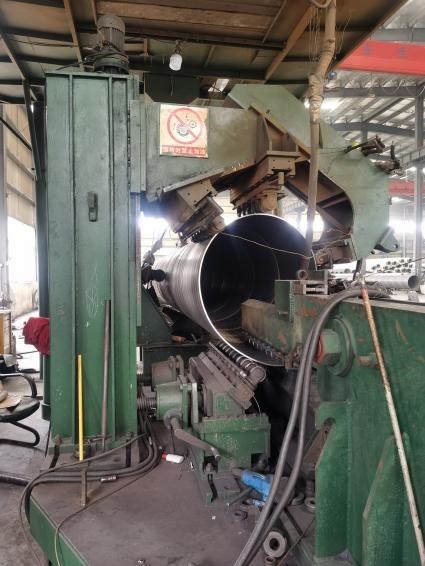
Spiral welded pipe production involves several stages, including steel strip uncoiling, leveling, forming, welding, and cut-to-length processing. During equipment evaluation, manufacturers should look beyond the individual specifications of the forming machine or welding system and determine whether all components can meet the requirements of the complete production line.
For example, the strip feeding system must work smoothly with the forming equipment, while the forming system must provide a properly shaped pipe blank for welding. The cutting system must also accommodate the target pipe dimensions and production cycle. If the capabilities of different machines are mismatched, bottlenecks and waiting time may occur, reducing overall production efficiency.
Manufacturers should therefore request a complete equipment configuration list from the supplier, including the functions, main specifications, scope of supply, and interface requirements of each component. This helps prevent situations in which essential auxiliary equipment or connection systems are discovered to be missing after procurement.

Match Production Capacity with Actual Order Requirements
The rated production capacity of a machine does not necessarily reflect the output a manufacturer can consistently achieve over the long term. Raw material changes, pipe specification adjustments, welding parameter settings, quality inspections, and routine maintenance all affect the effective operating time of a production line.
When selecting industrial spiral pipe production equipment, manufacturers should evaluate production capacity based on order volume, product specification distribution, and delivery schedules rather than focusing exclusively on maximum theoretical speed. For companies handling frequent specification changes and small-batch orders, convenient equipment adjustment may be more important than the highest production speed for a single specification. Manufacturers producing the same pipe specifications over extended periods may place greater emphasis on continuous operation and production cycle stability.
Before purchasing, manufacturers should confirm the product specifications, raw material conditions, and operating parameters used to calculate the supplier's rated capacity. Trial production or references from comparable installations can also help verify actual performance under similar operating conditions.
Evaluate the Control System and Quality Inspection Configuration
The control system determines how effectively different production stages coordinate with one another. It also affects how easily operators can adjust parameters and investigate production issues. When evaluating industrial spiral pipe production equipment, manufacturers should determine whether the system supports key parameter settings, operating status monitoring, fault alerts, and the necessary production data recording functions.
Quality inspection equipment is equally important. Based on the technical requirements of the finished pipes, manufacturers should confirm whether the production line includes appropriate dimensional measurement equipment, interfaces for weld inspection systems, or other necessary inspection components. Different inspection methods have different applications, so the final configuration should be determined according to relevant product standards and customer requirements.
Manufacturers should also review operator training, data backup arrangements, spare parts availability, and ongoing technical support. These considerations help prevent production disruptions caused by complicated operation or insufficient technical assistance after installation.
Calculate Installation and Maintenance Costs and Consider Future Expansion
The initial equipment purchase price represents only part of the total investment. Factory foundations, electrical requirements, installation and commissioning, operator training, replacement of wear parts, and routine maintenance also contribute to long-term operating costs.
When evaluating industrial spiral pipe production equipment, manufacturers should confirm installation conditions, energy requirements, maintenance intervals, and lists of critical spare parts in advance. They should also assess the supplier's technical support capabilities. Companies planning to expand production in the future should consider whether the production line allows reasonable upgrades, such as adding auxiliary machinery, upgrading inspection systems, or improving selected automation functions.
The most suitable equipment configuration is not necessarily the one with the most features or the highest purchase price. Instead, it should meet current production requirements, control long-term operating costs, and accommodate changes in the company's business needs.
Frequently Asked Questions (FAQ)
1. What should manufacturers prioritize when evaluating industrial spiral pipe production equipment?
Manufacturers should first confirm that the equipment can handle the required pipe diameters, wall thicknesses, and material specifications. They should then evaluate production line coordination, actual capacity, control systems, and maintenance requirements.
2. Is a higher equipment configuration always better?
Not necessarily. An unnecessarily advanced configuration may increase purchasing and maintenance costs, while features that are not required may remain unused. Manufacturers should select equipment based on order characteristics, quality requirements, and future development plans.
3. Should manufacturers confirm the complete production line configuration with the supplier before purchasing?
Yes. Manufacturers should obtain a detailed equipment list, technical specifications, scope of supply, installation requirements, and after-sales service information. Technical consultations or trial production may also be necessary to verify that the proposed configuration meets actual manufacturing needs.
Key words:
All
- All
- Product Management
- News
- Introduction
- Enterprise outlets
- FAQ
- Enterprise Video
- Enterprise Atlas
Related News
What Are the Key Criteria for Choosing a 1420mm Spiral Pipe Mill Manufacturer?
Learn how to choose a 1420mm Spiral Pipe Mill manufacturer by evaluating equipment quality, technical expertise, production capacity, and after-sales support.
2026-11-11
Discover how an Industrial Steel Pipe Mill improves dimensional accuracy, welding quality, automation, and production efficiency through precise process control.
2026-11-11
Automation Development Trends and Application Value of Heavy Duty Steel Pipe Manufacturing Equipment
Explore the automation trends and applications of heavy duty steel pipe manufacturing equipment, from welding and pipe-end processing to intelligent production control.
2026-11-10


Service E-mail
Hotline:
Address
Taiyuan City, Shanxi Province
To inquire about our products, please leave your email to us and we will contact you within 24 hours.