





Application of Carbon Steel Spiral Pipe Equipment in Large-Diameter Steel Pipe Production
20 Oct,2026
Huaye
Gain insights into the application, equipment selection, and key quality control points for carbon steel spiral pipe production—helping enterprises enhance their manufacturing efficiency.
With the development of energy transportation, urban water supply, infrastructure construction, and industrial piping projects, large-diameter steel pipes are becoming increasingly widely used across various engineering sectors. To meet the specific requirements for pipe diameter, wall thickness, length, and quality, steel pipe manufacturers require stable and efficient production equipment. Carbon steel spiral pipe equipment plays a vital role in the manufacturing of large-diameter steel pipes by utilizing a continuous steel strip forming and spiral welding process. Proper equipment configuration not only enhances production efficiency but also supports precise control over pipe dimensions and welding quality.
How Carbon Steel Spiral Pipe Equipment Produces Large-Diameter Steel Pipes
Carbon steel spiral pipe equipment is primarily used to process continuous steel strips into spiral-welded steel pipes. Compared to methods that process entire steel plates, the spiral forming process allows for the production of pipes with varying diameters by using steel strips of a specific width and adjusting the forming angle and other relevant process parameters.
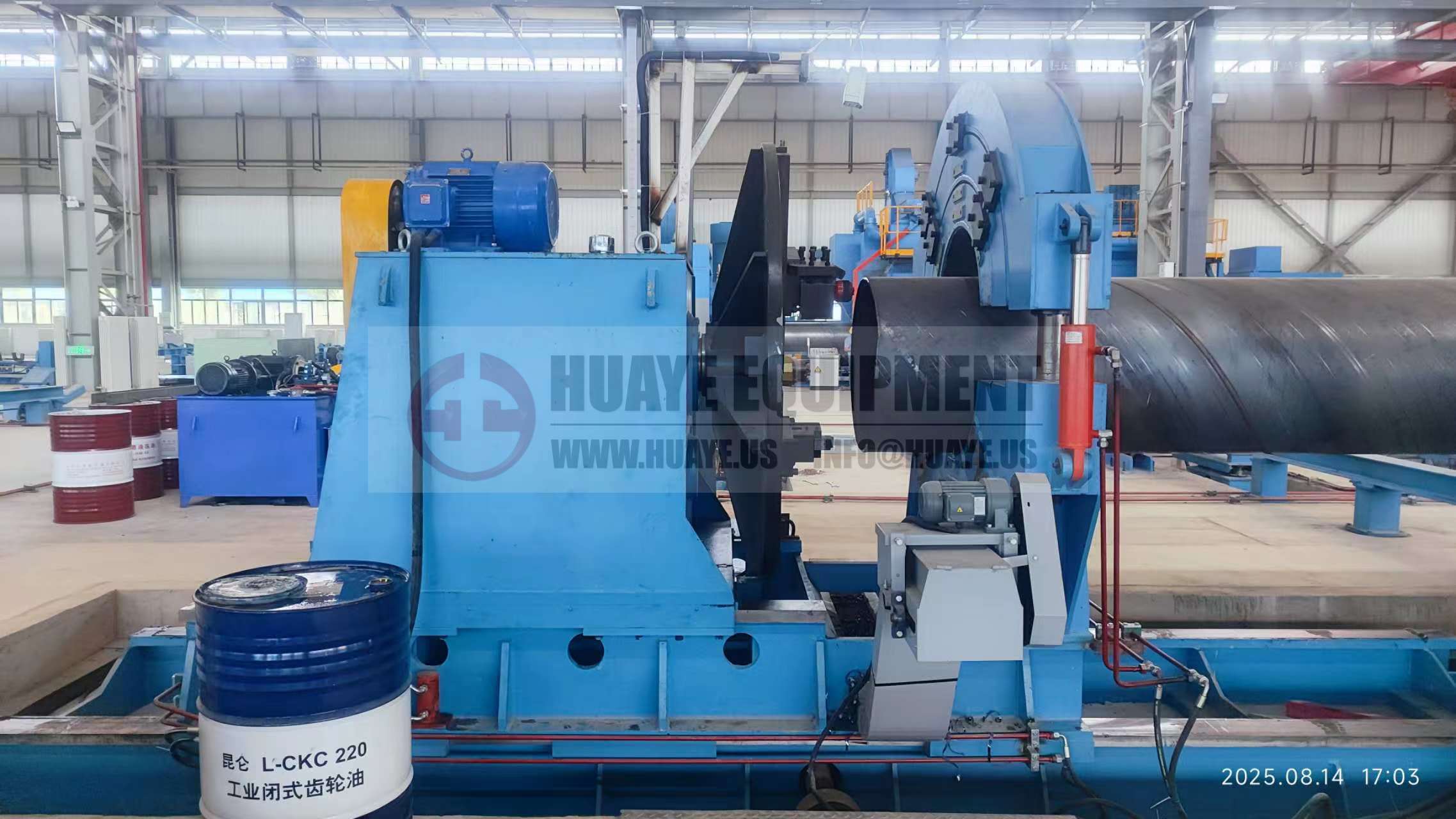
During production, the steel strip undergoes uncoiling, leveling, and conveying before entering the forming section. The equipment uses a forming mechanism to control the direction and curvature of the steel strip, gradually shaping it into a spiral tubular body. Simultaneously, a welding system continuously welds the seams, creating a stable, integrated structure.
Once formed and welded, the steel pipe is cut to the specified length, subjected to necessary inspections and post-processing, and finally undergoes a comprehensive quality check as a finished product.
For the production of large-diameter steel pipes, the equipment’s forming capacity, operational stability, and the configuration of its welding system are particularly critical. Seamless coordination between each stage of the process is essential to prevent issues such as unstable strip conveyance, dimensional deviations in the pipe, or fluctuations in welding quality.

Key Advantages of Carbon Steel Spiral Pipe Equipment in Large-Diameter Steel Pipe Manufacturing
1. Adaptability to Various Steel Pipe Specifications
Projects involving large-diameter steel pipes often entail diverse design requirements. Carbon steel spiral pipe equipment can accommodate a range of pipe diameters and wall thicknesses by adjusting forming parameters and relevant process settings. For enterprises that need to manufacture products with a wide range of specifications, this flexibility helps improve equipment utilization.
However, the actual range of producible specifications depends on factors such as the specific equipment model, steel strip width, material properties, and the design capacity of the forming mechanism; therefore, the processing range cannot be determined solely by the name of the equipment.
2. Support for Continuous Production
Under stable production conditions, the processes of continuous feeding, spiral forming, and welding can be integrated into a seamless production flow. An optimized equipment layout minimizes unnecessary waiting times between process steps, thereby enhancing the efficiency of production organization.
For steel pipe manufacturers handling large order volumes and relatively stable product specifications, a well-configured production line helps increase capacity and ensures greater consistency across different production batches.
3. Suitability for Diverse Engineering Applications
Large-diameter spiral-welded pipes made from carbon steel can be used—provided they meet relevant standards and technical requirements—for water supply pipelines, oil and gas transmission pipelines, foundation piling, and various industrial piping projects. Since different applications impose distinct requirements regarding steel grade, weld performance, dimensional tolerances, and inspection protocols, the equipment configuration must be aligned with the technical specifications of the intended products.

Equipment Configuration and Quality Control in Large-Diameter Steel Pipe Production
The performance of equipment used for carbon steel spiral pipes directly affects the stability of the production process; however, the ultimate quality of the steel pipes also depends on several other factors, including raw materials, welding processes, operational management, and inspection procedures.
First, equipment specifications must be determined based on the target pipe diameter, wall thickness, material grade, and required production throughput. If the equipment’s processing capacity is mismatched with the actual production requirements, it may be difficult to maintain stable, long-term production, even if basic forming can be achieved.
Second, precise control over the forming process is essential. Factors such as the width, thickness, and edge condition of the steel strip, as well as tension fluctuations during transport, can affect the pipe’s roundness, diameter, and the positioning of the weld seam. Manufacturers must set appropriate forming parameters and regularly inspect the operational status of critical mechanical components.
Welding quality is equally critical. Factors such as welding speed, welding parameters, the condition of the groove or edges, and the cleanliness of the material surface can all influence the formation and internal quality of the weld seam. For steel pipe products with strict quality requirements, appropriate non-destructive testing and performance inspections must be conducted in accordance with applicable standards.
Furthermore, equipment maintenance is crucial for ensuring continuous production. Enterprises should regularly inspect transmission mechanisms, forming rollers, guiding components, and welding systems, addressing issues such as wear, misalignment, or abnormal vibration promptly. Establishing a system for equipment inspections and production record-keeping helps identify recurring faults and reduces unplanned downtime.

Frequently Asked Questions (FAQs)
Q: What types of large-diameter steel pipes can be produced using carbon steel spiral pipe equipment?
A: This equipment is primarily used to manufacture carbon steel spiral-welded pipes within its specified capacity range. These pipes are suitable for applications such as water supply, energy transport, foundation piling, and various industrial piping projects. Specific applications should be determined based on the design requirements for the steel pipes and relevant industry standards.
Q: Which parameters are most important to consider when selecting carbon steel spiral pipe equipment?
A: Key parameters to evaluate include the range of pipe diameters and wall thicknesses that can be processed, the allowable steel strip width, the range of compatible materials, welding configurations, cutting capabilities, and production efficiency. Additionally, it is essential to verify that the equipment can meet the dimensional accuracy and quality requirements for the intended end products.
Q: Can carbon steel spiral pipe equipment produce steel pipes of different diameters?
A: Yes, within the limits of the equipment's design, it is possible to produce pipes of different diameters by adjusting the relevant forming parameters. However, the adjustable range depends on the equipment's structure and specific configuration; therefore, this should be confirmed with the manufacturer prior to purchase.
Q: How can the production quality of large-diameter steel pipes be improved?
A: Quality improvement requires a comprehensive approach, encompassing raw material inspection, control of forming parameters, management of the welding process, equipment maintenance, and inspection of finished products. Standardizing production workflows and promptly identifying any anomalies will help enhance the dimensional consistency of the pipes and the stability of weld quality.
Key words:
All
- All
- Product Management
- News
- Introduction
- Enterprise outlets
- FAQ
- Enterprise Video
- Enterprise Atlas
Related News

This analysis explores the key technologies that enable automatic steel pipe welding machines to accommodate steel pipes of varying wall thicknesses. It covers welding parameters, equipment configuration, process optimization, and quality control—helping enterprises enhance both welding efficiency and product quality.
2026-10-20
Application of Carbon Steel Spiral Pipe Equipment in Large-Diameter Steel Pipe Production
Gain insights into the application, equipment selection, and key quality control points for carbon steel spiral pipe production—helping enterprises enhance their manufacturing efficiency.
2026-10-20
Explore methods for adapting spiral-welded pipe machines to the production of various steel pipe specifications—covering equipment selection, material matching, forming processes, welding parameter adjustments, and production line configuration—to help enterprises optimize their steel pipe manufacturing workflows.
2026-10-15


Service E-mail
Hotline:
Address
Taiyuan City, Shanxi Province
To inquire about our products, please leave your email to us and we will contact you within 24 hours.