





What Should Be Considered When Installing and Commissioning an industrial pipe machine?
29 Oct,2026
Huaye
Proper installation of an industrial pipe machine requires careful planning, accurate alignment, electrical inspection, performance testing, and routine maintenance.
For steel pipe manufacturers, installing and commissioning an industrial pipe machine is an essential step before production begins. Installation quality affects not only equipment stability but also pipe forming accuracy, welding quality, and subsequent maintenance costs. Problems such as an unstable foundation, incorrect equipment positioning, or improper parameter settings may reduce production efficiency and disrupt the operation of the entire production line. Therefore, manufacturers should carefully plan installation preparation, equipment alignment, electrical connections, parameter adjustments, and acceptance procedures.
Prepare Thoroughly Before Installation
Before installing an industrial pipe machine, manufacturers should inspect the site according to the equipment's technical documentation. This includes confirming the installation area's dimensions, floor load-bearing capacity, and conditions for equipment transportation and lifting. Installation tools, lifting equipment, and appropriate safety gear should also be prepared in advance to avoid unnecessary delays.
In addition, manufacturers should verify the equipment model, main components, accessories, and technical documents. All parts should be inspected for damage during transportation or loose connections. For steel pipe production equipment consisting of multiple functional units, the installation sequence and connections between different machines should be clearly defined to provide a solid foundation for subsequent commissioning.

Ensure Accurate Positioning and Mechanical Installation
Equipment positioning is a critical step in installing an industrial pipe machine. Installation personnel should position the machine according to the manufacturer's technical requirements and check foundation levelness, installation centerlines, and the relative positions of individual components.
An uneven machine base or misaligned components may cause abnormal vibration, increased mechanical wear, and inconsistent pipe dimensions during operation. After securing the equipment, installers should recheck the anchor bolts, connecting components, and key mounting points to ensure that the mechanical structure is firmly installed.
For interconnected equipment used in uncoiling, feeding, forming, welding, and cutting, the alignment of centerlines between production stages also requires attention. Proper alignment helps ensure that steel strips and pipes move smoothly along the intended production path.
Inspect the Electrical and Control Systems
Modern industrial pipe machine systems are generally equipped with motor drives, control cabinets, sensors, and related automation components. Before powering on the equipment, qualified technical personnel should inspect the power supply parameters, grounding protection, electrical wiring, and control components to ensure that all connections meet the equipment requirements.
During control system commissioning, operators should check the functionality of operating buttons, emergency stop devices, limit switches, and safety interlocks. The rotation direction of each motor should also be verified to prevent mechanical damage caused by incorrect wiring or incompatible control settings.
For equipment equipped with automated control systems, sensor signals, parameter displays, and fault alarm functions should be tested. These checks help operators monitor equipment conditions and respond to abnormal situations according to established procedures.
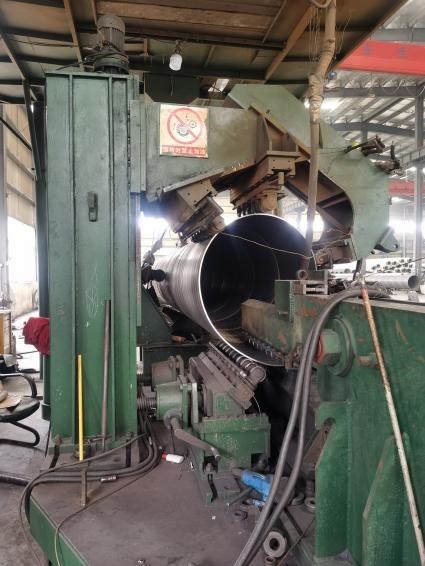
Conduct No-Load and Load Testing Properly
After completing mechanical and electrical inspections, commissioning should proceed according to the manufacturer's specified procedures. No-load testing is generally performed first to observe equipment startup, shutdown, transmission, and control functions. During this stage, technicians should check for abnormal noise, vibration, temperature increases, or interference between moving components.
Once no-load operation is confirmed to be normal, loaded testing can gradually begin within the equipment's design capacity. For steel pipe production equipment, key inspection points include feeding stability, forming performance, pipe dimensions, and welding quality. Relevant parameters can then be adjusted according to the actual test results.
Manufacturers should avoid immediately operating the equipment at high loads using unverified settings. Operating parameters should be established progressively in accordance with the equipment manual and production requirements. If any abnormalities occur, the machine should be stopped and inspected promptly to prevent minor problems from developing into serious failures.
Focus on Production Accuracy and Process Coordination
Commissioning an industrial pipe machine should involve more than confirming that the main machine operates normally. Manufacturers must also verify coordination across the entire production line. For steel pipe manufacturers, the connection between feeding, forming, welding, fixed-length cutting, and subsequent processing directly affects product quality and production rhythm.
During trial production, manufacturers should inspect pipe diameter, roundness, length, and weld quality according to the applicable product standards. If dimensional deviations or process coordination problems occur, the causes should be investigated by examining equipment structure, process parameters, and the condition of supporting machinery rather than simply increasing production speed.
Manufacturers should also record key commissioning parameters, equipment operating conditions, and inspection results. These records provide a reliable reference for subsequent mass production and troubleshooting.

Complete Acceptance, Training, and Routine Maintenance
After commissioning, manufacturers should conduct equipment acceptance according to the purchase contract and technical agreement. The acceptance process should verify that equipment performance, production indicators, safety functions, and supporting systems meet the agreed requirements. Any problems identified during trial production should be documented and resolved before formal production begins.
Operators and maintenance personnel should also receive appropriate training to become familiar with operating procedures, common troubleshooting methods, and routine inspection requirements. Manufacturers can establish regular lubrication schedules, fastener inspections, wear-part checks, and equipment operating records to help extend the machine's service life.
Key words:
All
- All
- Product Management
- News
- Introduction
- Enterprise outlets
- FAQ
- Enterprise Video
- Enterprise Atlas
Related News
What Are the Key Criteria for Choosing a 1420mm Spiral Pipe Mill Manufacturer?
Learn how to choose a 1420mm Spiral Pipe Mill manufacturer by evaluating equipment quality, technical expertise, production capacity, and after-sales support.
2026-11-11
Discover how an Industrial Steel Pipe Mill improves dimensional accuracy, welding quality, automation, and production efficiency through precise process control.
2026-11-11
Automation Development Trends and Application Value of Heavy Duty Steel Pipe Manufacturing Equipment
Explore the automation trends and applications of heavy duty steel pipe manufacturing equipment, from welding and pipe-end processing to intelligent production control.
2026-11-10


Service E-mail
Hotline:
Address
Taiyuan City, Shanxi Province
To inquire about our products, please leave your email to us and we will contact you within 24 hours.